
Menu
If you’re exploring the possibility of becoming a surrogate, you’ve likely come across one requirement that raises a lot of questions: Body Mass Index, or BMI.
For many women, seeing a BMI requirement can feel discouraging or even personal. You may have had healthy pregnancies before, lead an active lifestyle, and still wonder why this number matters so much. That’s a completely understandable reaction.
BMI is not used to judge your overall health, appearance, or ability to be a great surrogate. Instead, it’s one of several medical screening tools that fertility specialists use to help reduce risks and support the healthiest possible pregnancy for everyone involved.
In this article, we’ll explain what BMI is, why fertility clinics include it as part of their screening process, how it can affect IVF and pregnancy, and what it means if your BMI falls outside a clinic’s preferred range.
Body Mass Index (BMI) is a calculation that compares your height and weight to estimate whether your body falls within a general weight range for your height.
Healthcare providers typically group BMI into broad categories. A BMI below 18.5 is considered underweight, between 18.5 and 24.9 is generally considered a healthy weight, between 25 and 29.9 falls into the overweight category, and a BMI of 30 or higher is categorized as obesity. These categories are intended to help providers identify patterns of health risk across large populations rather than evaluate an individual’s overall health.
While BMI is commonly used in medicine, it does have limitations. It doesn’t distinguish between muscle and body fat, account for body composition, or reflect a person’s fitness level, eating habits, or overall wellness. Two people with the same BMI can have very different health profiles.
Because of these limitations, BMI is only one piece of the bigger picture. Fertility clinics also look at your medical history, previous pregnancies, lifestyle, and overall health before determining whether you’re a good candidate for surrogacy.
The easiest way to find your BMI is by using a simple online BMI calculator. All you’ll need is your height and current weight, and the calculator will do the rest.
If you’d rather calculate it yourself, the formula is:
BMI = Weight (kg) ÷ Height² (m²)
Most people don’t need to do the math by hand—using an online calculator is much quicker and easier. Once you know your BMI, you’ll have a better idea of where you fall within the general screening guidelines used by fertility clinics.
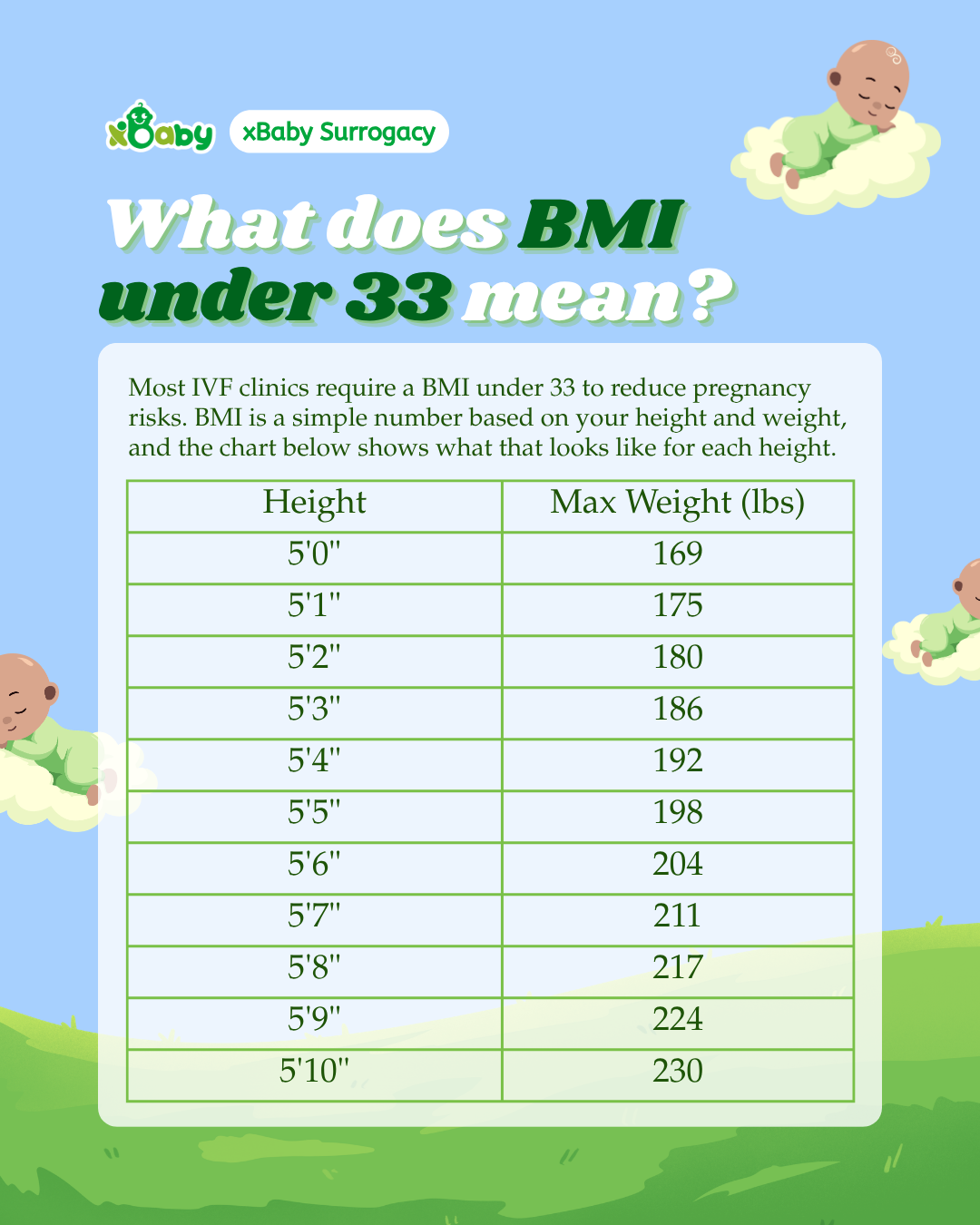
Many women are surprised to learn that even a small change in weight can affect BMI, particularly if they’re close to a clinic’s guideline. If your BMI is near the cutoff, don’t assume you won’t qualify—our team can help you understand what your options may be and whether there are clinic partners whose requirements align with your profile.
The goal of every surrogacy journey is the same: a healthy pregnancy, a healthy baby, and a safe experience for the surrogate.
Although many women with higher BMIs have healthy pregnancies and deliveries, medical research has shown that, across large groups of people, certain pregnancy complications become more common as BMI increases. Because surrogacy involves IVF, multiple medical providers, and intended parents who have invested emotionally and financially in the process, fertility clinics aim to minimize as many avoidable risks as possible before treatment begins.
Higher BMI has been associated with an increased likelihood of:
It’s important to remember that these are potential risks, not guarantees. Having a BMI above a certain number does not mean someone will experience complications, just as having a lower BMI doesn’t guarantee a complication-free pregnancy. Instead, clinics rely on research and statistics to create screening guidelines that give intended parents and surrogates the best possible chance of a healthy outcome.
Surrogacy pregnancies begin differently than most pregnancies. Rather than conceiving naturally, a surrogate undergoes an embryo transfer through in vitro fertilization (IVF).
Before an embryo transfer takes place, fertility specialists work to optimize every factor they can control. This includes reviewing the health of the uterus, hormone levels, medical history, and overall pregnancy risk.
Research suggests that a higher BMI may be associated with:
It’s worth noting that embryo quality, uterine health, and previous pregnancy history also play significant roles in IVF success. BMI is simply one factor among many that clinics consider when deciding whether it’s medically appropriate to move forward.
One of the most common questions women ask is:
“If women with higher BMIs have healthy pregnancies every day, why are surrogacy requirements different?”
The answer lies in the unique nature of surrogacy.
Unlike a naturally conceived pregnancy, surrogacy is a carefully planned medical process involving fertility specialists, legal agreements, insurance providers, and intended parents who are placing tremendous trust in the process.
Before an embryo is transferred, clinics have an opportunity to evaluate medical factors that could influence pregnancy outcomes. Because they have that opportunity, they often choose to be more conservative than routine obstetric care.
Their objective isn’t to determine who is capable of becoming pregnant. Instead, they’re looking for candidates who statistically have the greatest chance of:
These guidelines are designed to support everyone involved—not to judge an individual’s health or worthiness.
One thing that surprises many prospective surrogates is that there isn’t one universal BMI requirement.
Every fertility clinic establishes its own medical guidelines based on its physicians’ experience, clinical research, pregnancy outcomes, and overall approach to risk management.
Some clinics are comfortable working with surrogates whose BMI falls in the low 30s, while others prefer candidates whose BMI is below 30—or even below the upper 20s.
This means it’s entirely possible for someone to meet one clinic’s requirements but not another’s. It doesn’t necessarily reflect a difference in health; it simply reflects that different clinics have different standards for the patients they treat.
At xBaby Surrogacy, we welcome applications from women whose BMI is under 33.
This guideline allows us to begin the screening process with candidates who are likely to meet the medical criteria used by many fertility clinics. However, it’s important to understand that every fertility clinic has its own requirements.
Many of the clinics we partner with have more conservative BMI guidelines, with some preferring surrogates whose BMI is 30 or below, while others may require a BMI in the upper 20s before approving an embryo transfer.
If your BMI is close to one of these thresholds, it doesn’t automatically mean surrogacy isn’t an option. Our team reviews each application individually and can help you understand what requirements may apply based on the clinics involved in your journey.
Our goal is to be transparent about the process while helping prospective surrogates navigate it with realistic expectations and support.
Although BMI receives a lot of attention, it’s only one factor that fertility specialists consider.
A comprehensive medical review also looks at:
For many intended parents and fertility clinics, a history of healthy, uncomplicated pregnancies is one of the strongest indicators that someone may be an excellent surrogate candidate.
The screening process is designed to evaluate the whole person—not just a single number.